
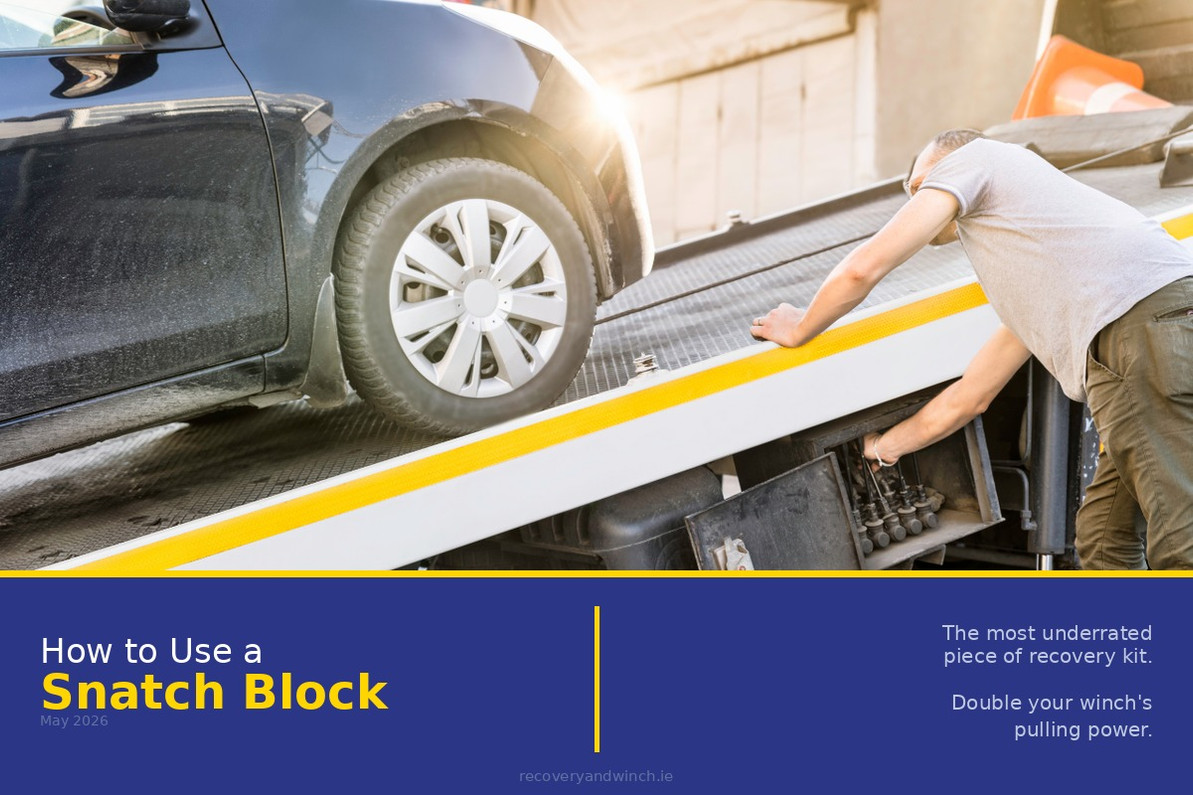
How to Use a Snatch Block (And Why It's the Most Underrated Piece of Recovery Kit)
The Most Underrated Piece of Recovery Kit
Ask any recovery operator what the most useful single item in their kit is and you will get a few different answers, but the snatch block belongs somewhere near the top of every list. It is a simple pulley, usually mounted between two steel side plates with a hinged opening so you can drop a winch rope into it without unspooling. There are no moving parts beyond the central wheel, and nothing electronic about it.
Yet a snatch block can take a winch that will not move a stuck vehicle and turn it into one that pulls comfortably. It can save your rope, your anchor, and on the worst days possibly your fingers. Despite all that, it is still the piece of kit most people skip when building out their recovery setup.
This guide covers what a snatch block actually does, how it doubles your effective pulling power, how to rig one correctly, and when a double-line pull is the right answer.
What a Snatch Block Actually Does
The mechanical principle is straightforward. When you pull a load directly with a winch, the rope carries the full weight of whatever you are moving. Hook one end of the rope to your anchor, run it through a snatch block attached to the load, and bring it back to the winch, and you have created a double line. The load is now shared between two parts of rope, which means the winch only has to pull half the weight.
In practice that means a winch rated at 4,500 kg can effectively pull a 9,000 kg load when set up this way. You also halve the pull speed, which sounds like a downside but is actually a benefit when you need fine control over a heavy or awkward load. A slower pull is a safer pull.
The other thing a snatch block does is redirect the line of pull. If a stuck vehicle is not sitting directly in front of or behind your anchor, you cannot just winch in a straight line. Anchor the block off to one side, run the rope through it, and you can pull from any angle. That is a problem-solver in tight terrain like green lanes, ditches, and wooded recovery sites.
Choosing the Right Snatch Block
The single most important rule when buying a snatch block is that its working load limit should be at least double your winch’s rated pulling capacity. A 4,500 kg winch needs a snatch block rated to at least 9,000 kg. This is because the block carries the full load of both rope sections, so it sees twice what either single rope does.
Look for blocks with rated bow shackle holes, sealed bearings, and rope-diameter ratings that match your winch line. Steel rope works with any standard snatch block. Synthetic rope needs a block with a smooth-walled, larger-diameter sheave to avoid kinking and abrasion. Plenty of modern blocks are designed for both, but check the specification before buying.
Rigging It Correctly
Setting up a double-line pull is simple but easy to get wrong if you rush it. Here is the safe sequence.
First, choose a strong anchor point. A second vehicle works, but for serious pulls a sturdy tree wrapped with a tree trunk protector is the gold standard. Do not loop a winch rope directly around a tree — you will damage both the bark and the rope.
Second, hook the snatch block to the stuck vehicle’s rated recovery point using a properly rated bow shackle. The shackle pin should be finger-tight and then backed off a quarter turn so it does not seize under load.
Third, run your winch rope through the snatch block, around the wheel, and back to your own vehicle’s recovery point or to the anchor. You are effectively creating a loop with the block at the apex.
Fourth, lay a winch damper, recovery blanket, or even a heavy jacket over the rope between the winch and the block. If the rope or a shackle lets go under load, the damper absorbs the energy.
Once the system is rigged, take up the slack slowly, check every connection, and only then begin the pull. Anyone not directly needed for the recovery should be well clear of the lay of the rope.
Common Mistakes That Cause Problems
Two errors come up again and again. The first is using an undersized snatch block. A 4,000 kg-rated block on a 9,000 lb winch is asking for a bent or split block at the worst possible moment. The second is anchoring the block to something that will not hold, like a vehicle tow ball or a bumper bracket. Use a proper rated recovery point, every time.
The third mistake is forgetting that synthetic winch rope needs the right block. Running synthetic line through a small, sharp-edged steel pulley will shred it in seconds. If you have switched from steel to synthetic, check that your block is rated for it.
When You Actually Need a Double-Line Pull
You do not reach for the snatch block every time. If the load is well within your winch’s capacity and the line is clear, a straight pull is faster and simpler. The snatch block earns its place when the load is heavy enough that your winch is approaching its limit, when the angle of pull is not aligned with the anchor, when you need to redirect around an obstacle, or when you are working with older kit and want to ease the load on the winch motor.
In any of those situations, a snatch block converts a slow, struggling pull into a controlled, comfortable one. That is why it lives at the top of every serious recovery kit.
Get Yours Set Up Right
If you are putting together a recovery setup, do not leave the snatch block until last. Pair it with a properly rated recovery strap or tree protector and a couple of bow shackles and you have added serious capability to whatever winch you are running. Browse the snatch block range and the rest of the recovery kit at Recovery and Winch to round out your setup.
Need advice? Call us on 071 961 6992 or email sales@recoveryandwinch.ie
Recent Posts
-
How to Use a Snatch Block (And Why It's the Most Underrated Piece of Recovery Kit)
The Most Underrated Piece of Recovery Kit Ask any recovery operator what the most useful single item …29th May 2026 -
Building Your Vehicle Recovery Kit: What Every Driver Actually Needs
Why a Recovery Kit Matters More Than You Think If you run a recovery truck or a car transporter, you …22nd May 2026 -
Why We Back Champion — And Why You Should Too
We sell a lot of gear at Recovery and Winch — winches, hoists, recovery equipment, lighting — and we …15th May 2026